
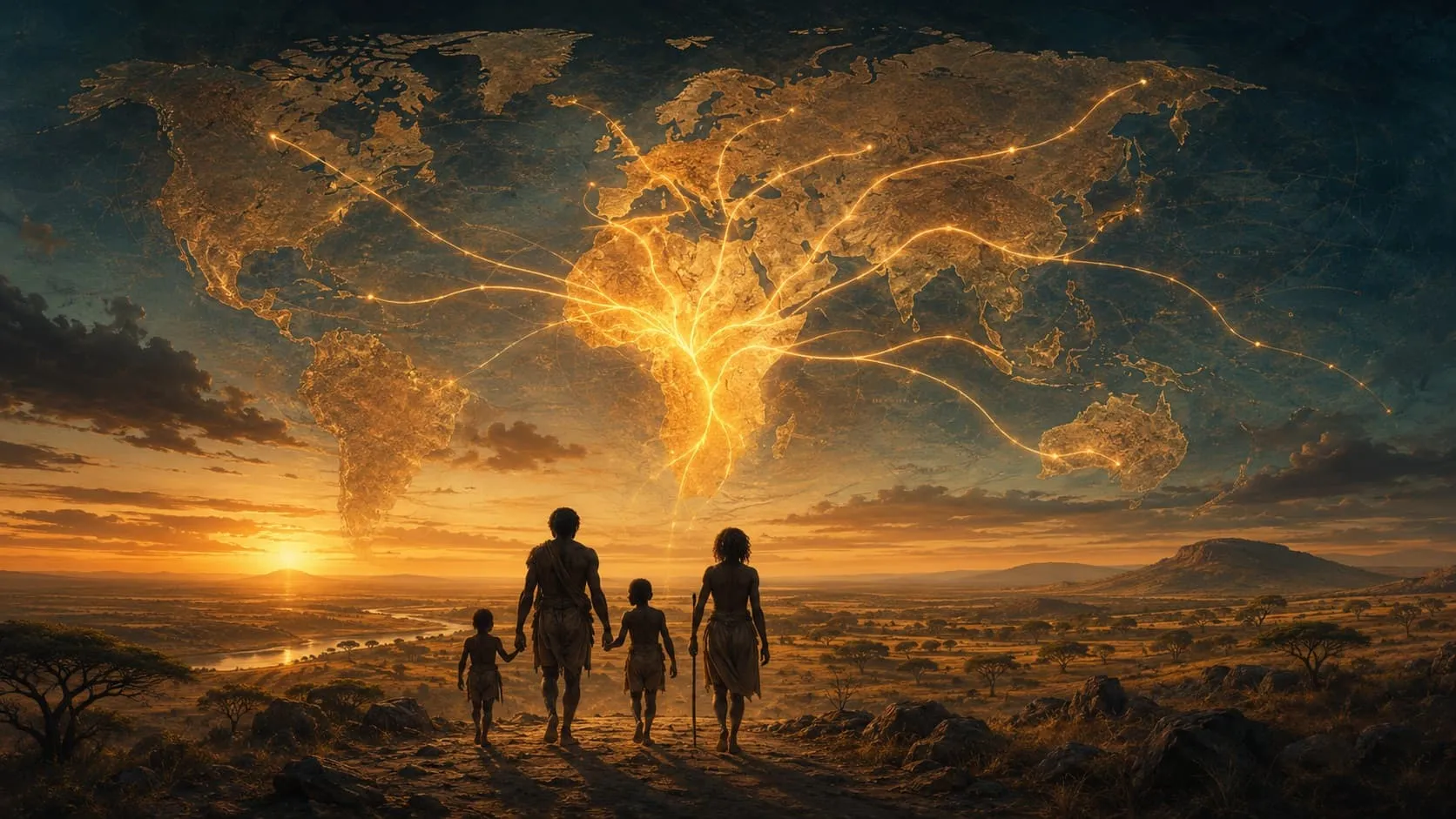
Human migration is one of the biggest stories in our species’ history, but most ancient movements left no written explanation. Researchers therefore have to rebuild the past from traces that survived: bones, tools, settlement remains, DNA, languages, climate records, and later historical documents. No single clue can explain an entire migration. The strongest reconstructions come from combining several independent lines of evidence and asking whether they point in the same direction.
Evidence Works Best in Combination
A useful overview of the types of evidence for human migration includes archaeology, fossils, ancient DNA, modern genetics, linguistics, written records, oral traditions, climate science, and isotope analysis. Each method answers a different kind of question.
Archaeology can show where people lived and what they made. Fossils can identify hominin presence in particular regions. Ancient DNA may reveal biological relationships or admixture between populations. Isotope analysis can sometimes show whether an individual grew up in the same place where they were buried. Climate records help explain whether changing environments opened or closed possible migration routes.
Archaeology Shows Presence and Change
Material remains are often the first evidence that people occupied a place. Stone tools, pottery, settlements, food remains, graves, and trade objects can establish human activity and sometimes reveal changes over time.
However, a new style of pottery does not automatically prove that a new population arrived. Ideas and objects can spread through exchange without large-scale migration. Researchers therefore compare material culture with biological and environmental evidence before making stronger claims about population movement.
Genetics Adds Another Layer
Ancient DNA has transformed the study of population history because it can reveal relationships that material culture alone may not show. Genetic evidence has helped researchers identify episodes of admixture, population turnover, and long-distance movement.
Even so, DNA has limits. Genetic ancestry is not the same as language, nationality, religion, or cultural identity. A genome can help reconstruct biological relationships, but it cannot directly tell researchers what language a person spoke or how that person understood their identity.
Places Have Layered Histories
A population history by country is rarely the story of one population remaining unchanged in one territory. Modern political borders are recent compared with most human migration. The same geographic region may have experienced repeated settlement, movement, trade, conquest, intermarriage, displacement, and cultural change.
For that reason, studying a country’s population history means looking at the land across many periods rather than projecting the modern state backward into prehistory. A present-day country can contain evidence of ancient foragers, farmers, pastoralists, imperial movements, historic diasporas, and modern migration.
Language Can Suggest Movement
Languages also carry historical information. Related languages may preserve shared vocabulary and grammatical features that point to a common linguistic ancestor. Their geographic distribution can help researchers develop models for how speech communities expanded.
Yet language spread does not always require mass migration. A language can spread through trade, political power, intermarriage, education, or elite influence. This is why linguistic evidence is strongest when compared with archaeology and genetics rather than treated as a direct map of ancestry.
Climate Helps Explain Routes
People migrate for many reasons, but environment can shape which routes are possible. Changing rainfall, expanding deserts, shifting coastlines, and glacial cycles have repeatedly altered the landscapes available to human populations.
Pollen, lake sediments, ice cores, and other environmental records can help researchers reconstruct those conditions. Climate does not by itself explain why a population moved, but it can show when a corridor became more or less habitable.
Uncertainty Is Part of the Research
Migration history changes when new evidence appears. A newly dated site can push a known occupation earlier. DNA from a previously unsampled region can reveal unexpected ancestry. A revised language reconstruction can challenge an older model.
This does not mean the field lacks reliable knowledge. It means good research distinguishes between what is well supported, what is probable, and what remains debated.
Conclusion
Reconstructing human migration requires more than finding one dramatic fossil or one genetic result. Archaeology, DNA, fossils, languages, isotopes, climate records, written sources, and oral traditions contribute different pieces of the story.
The best population histories are therefore layered and cautious. They ask where people lived, when movement occurred, what evidence supports it, and how later populations changed the picture. By combining several methods instead of relying on one, researchers can build a more complete account of how people came to inhabit the places we know today.